25 Cat SVG: Graphics & Crafts Design Asset Review
As a graphic designer who’s built brand identities for handmade businesses, launched seasonal Etsy collections, and developed packaging for indie pet-product lines, I recently evaluated 25 Cat SVG for a real client project: a spring-themed “Cat & Tea” subscription box for a small-batch ceramicist and herbalist. The goal was warm, whimsical, and tactile—think hand-lettered labels, soft watercolor backgrounds, and playful but polished illustrations that feel intentional, not clipart-y. That’s where this design bundle entered the frame.
A First Impression That Feels Hand-Drawn, Not Stock
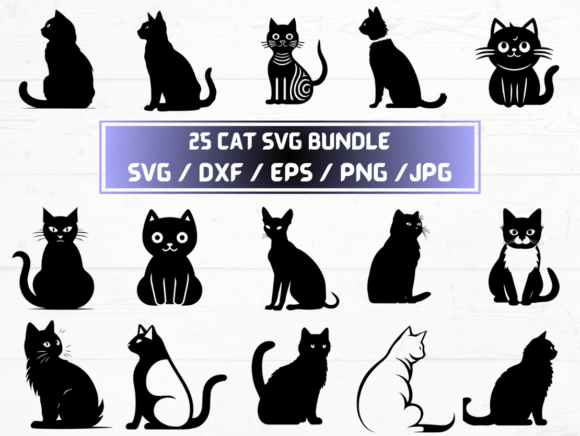
Opening the ZIP folder, I was immediately struck by how cohesive the 25 Cat SVG set feels—not like a scatter of generic felines, but a curated visual language. Each cat has distinct posture, expression, and line weight: curled napping silhouettes, curious upright poses, playful paws-in-air moments, and one or two with subtle floral or teacup motifs woven into their outlines. The style lands squarely in modern illustration territory—clean vector shapes, gentle curves, and consistent stroke rhythm—without veering into over-polished digital sterility. It reads as friendly, approachable, and quietly confident—ideal for brands rooted in craftsmanship, care, and personality.
Where This Graphic Design Asset Earns Its Place in Real Projects
In our client’s packaging design, 25 Cat SVG became the unifying visual thread across multiple touchpoints. We used a medium-scale seated cat (SVG) as a central motif on the box lid, layered it subtly behind product mockups as a watermark texture, and pulled individual cats as decorative accents on tea tag labels and thank-you cards. The SVG files scaled flawlessly from 2" stickers to 12" wall art prints—no pixelation, no jagged edges. The included PNGs at 300 dpi with transparent background worked seamlessly in Photoshop for social media graphics and Canva templates; we dropped them onto pastel gradients and textured paper scans without haloing or edge artifacts.
For Cricut projects and sublimation design, the DXF and EPS files proved essential—especially when cutting vinyl for reusable tote bags or heat-pressing mugs. The vector paths were clean and closed, with no stray anchor points or overlapping strokes that cause cutting errors. As a t-shirt design element, the cats held up beautifully at chest-print size, and their simplified forms translated well to embroidery digitizing (with minor path simplification).
Best Used In These Contexts
- Hero graphics for landing pages and email headers—especially paired with soft serif or rounded sans-serif fonts
- Printable design collections: wall art, greeting cards, planner stickers, and themed activity sheets
- Packaging details—corner flourishes, border repeats, or die-cut window accents
- Social media graphics, particularly Instagram carousels and Pinterest pins where charm and clarity drive engagement
- Brand identity extensions, like branded merchandise, limited-edition merch drops, or local event flyers
Use With Intention—Not Everywhere
This isn’t a universal solution. In minimalist branding systems—say, a luxury pet wellness startup using strict monochrome palettes and ultra-thin typography—the cats can overwhelm visual hierarchy. Their expressive nature competes with tight typographic rhythm and risks diluting perceived professionalism if used without careful spacing and contrast control. I’d avoid placing them directly over busy photographic backgrounds or low-contrast gradients unless masked or overlaid with subtle drop shadows.
At very small sizes (<12px height), some cats lose legibility—particularly those with fine interior details like whiskers or paw pads. For favicon use or tiny app icons, stick to the most silhouette-driven variants only after testing at actual scale.
Designer Notes You Can’t Skip Before Client Use
Before embedding 25 Cat SVG into any commercial design, run these checks:
- Test in black and white—verify shape recognition and silhouette strength without color cues
- Preview on both light and dark backgrounds—the PNG transparency holds up, but contrast shifts affect emotional tone
- Scale it down to 16px and up to 24" wide—confirm crispness and proportion integrity
- Place it on real product mockups—not just flat previews—to assess balance and context fit
- Run a test print on your intended substrate (kraft paper, glossy sticker stock, cotton fabric)—vector fidelity doesn’t guarantee ink bleed or texture absorption behavior
- Inspect SVG paths in Illustrator: Are layers named? Are groups ungroupable? Is text converted to outlines?
- Pair with fonts: It harmonizes best with friendly sans-serifs (like Poppins or Quicksand), gentle scripts (e.g., Pacifico), and soft display fonts—but clashes with rigid geometric or high-contrast serifs unless intentionally juxtaposed
- Confirm commercial license terms—this is a creative marketplace asset, and client deliverables require explicit permission for resale, POD, and digital distribution
Final Verdict: A Thoughtful Creative Asset, Not Just Clipart
25 Cat SVG stands out because it bridges craft and commerce thoughtfully. It’s not just a design bundle—it’s a mood, a voice, and a versatile toolkit for small business branding that values authenticity over algorithmic polish. For editorial design, Etsy product listings, print-on-demand storefronts, and handmade business launches, it delivers cohesion, scalability, and emotional resonance—when used with intention. If your client needs warmth, wit, and visual consistency without sacrificing professional execution, this graphic design asset earns its place in the working toolkit.