Cactus SVG: Graphics for Crafts & Local Branding
As a brand designer who’s developed visual identities for over 40 local businesses—from desert-themed coffee roasters in Tucson to handmade soap studios in Austin—I opened Cactus SVG expecting cliché. What I found instead was a surprisingly versatile, well-executed graphic design asset that breathes quiet confidence into small business branding. It doesn’t scream “trendy”—it settles in like a trusted collaborator.
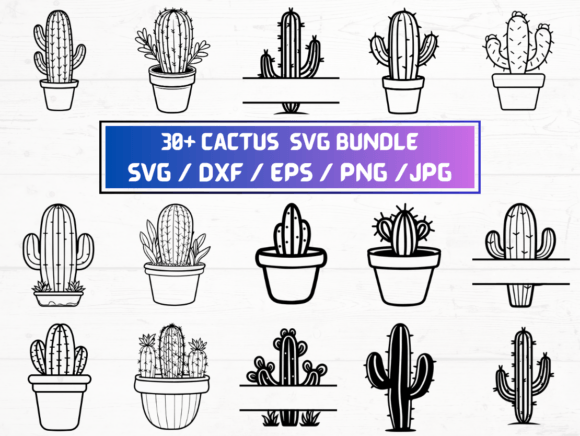
The first impression? Warm, grounded, and quietly intentional. These aren’t cartoonish or overly stylized cacti. They lean into organic line work, subtle tapering stems, soft spines, and balanced negative space—evoking handmade authenticity without sacrificing polish. The mood is friendly but focused, organic but intentional, desert-inspired but universally approachable. This makes Cactus SVG ideal for food businesses (think artisanal hot sauce labels or cold-brew coffee bags), skincare brands using natural ingredients, boutique gift shops, candle makers, and children’s product lines seeking gentle botanical charm—not kitsch.
Where does it shine in real-world use? Immediately on product labels and packaging design. I recently used one of the medium-weight outline variants as a subtle border element on matte-finish soap labels for a Santa Fe–based herbal apothecary. Paired with a serif typeface and warm kraft paper, it elevated shelf appeal without competing with ingredient callouts. It also worked beautifully as a hero graphic on their Instagram carousel ads—scaled large, crisp in SVG format, and instantly recognizable across devices.
For local business owners juggling multiple touchpoints, Cactus SVG delivers cross-platform consistency. Use the high-res PNGs (300 dpi, transparent background) for social media graphics and printable inserts; deploy the vector EPS and SVG files for scalable logo design adaptations, business cards, or embroidered hang tags; leverage the DXF files if you’re laser-cutting wooden coasters or acrylic display stands. Even the JPGs hold up well for quick web banners or email headers—no pixelation, no guesswork.
This asset strengthens professional branding by reinforcing visual hierarchy. A single cactus motif, placed intentionally beside a brand name or product title, creates instant recognition—especially important for boutiques or farmers’ market vendors where customers scan quickly. It signals care in presentation, which builds customer trust. In packaging design, that subtle botanical accent tells shoppers: *This isn’t mass-produced. This was considered.*
It supports small business branding most powerfully when used as a decorative brand element—not the hero, but the harmonizer. Think: a repeating cactus pattern along the bottom edge of a thank-you card, a minimalist cactus icon anchoring a price list at a plant shop, or a scaled-down version framing a seasonal campaign banner (“Summer Succulent Sale”). On product mockups, it adds warmth and context without overwhelming the product itself—a critical balance for handmade business owners selling on Etsy or local pop-ups.
Use Cactus SVG carefully in these scenarios: formal corporate branding (its warmth reads too personal for law firms or financial advisors), ultra-minimalist luxury brands (where even one decorative element can dilute restraint), or crowded packaging layouts with dense legal text or ingredient lists. Avoid placing it directly over low-contrast backgrounds—test it against your label substrate first. And never assume it works at tiny sizes: preview it at actual print dimensions on a 2” x 3” soap label before finalizing.
Here’s what I always test before committing Cactus SVG to client work: First, drop it into a real product mockup—not just a digital preview, but a printed proof on the actual packaging stock. Second, convert it to grayscale: does the line weight hold up for black-and-white printing (like on kraft tags or newsprint flyers)? Third, layer it beside every font in your brand system—serif, sans serif, script, handwritten—to ensure it doesn’t visually clash or compete. Fourth, check SVG editability: can you easily adjust stroke weight or isolate a single spine for custom adaptation? Finally—and non-negotiably—verify the commercial license. This isn’t clipart for hobby use; it’s a digital product supporting real revenue streams, so confirm it covers physical product sales, social media graphics, and client-facing commercial design.
For creative entrepreneurs building marketing visuals on tight timelines, Cactus SVG is a time-saver with integrity. Unlike generic Canva templates or overused marketplace illustrations, it offers stylistic cohesion across file types—meaning your sticker sheet matches your website banner, which matches your menu board, all while feeling bespoke. That consistency compounds across touchpoints: a customer sees the same delicate cactus motif on your jar label, your Instagram Story highlight, and your receipt tape—and subconsciously registers your brand as thoughtful, unified, and trustworthy.
In editorial design or web design contexts, it functions elegantly as an anchor point—guiding the eye without demanding attention. I’ve used a simplified variant as a bullet icon in a newsletter about sustainable packaging, and another as a subtle divider between sections on a boutique’s “Our Process” page. Its adaptability across mediums proves it’s more than clipart; it’s a flexible illustration system built for handmade business realities.
If you’re evaluating Cactus SVG for your bakery’s seasonal chia seed packaging, your candle brand’s holiday collection, or your florist’s thank-you cards—you’re not just buying files. You’re investing in a cohesive, scalable piece of your brand identity. Used with intention, it doesn’t distract—it deepens. It doesn’t decorate—it connects. And in today’s saturated market, that quiet resonance is exactly what helps a local business stand out—not louder, but clearer.